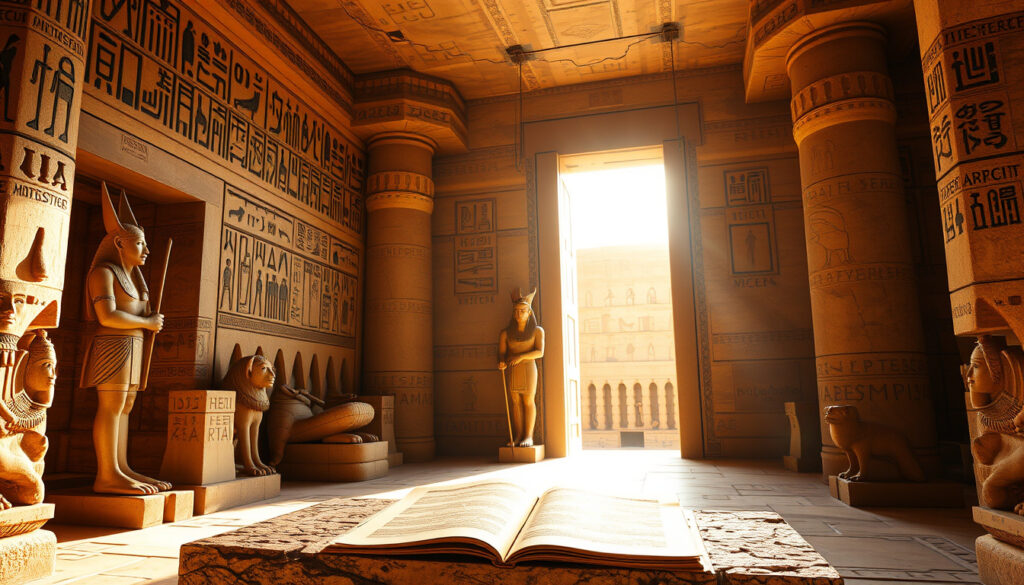
Egyptian Gods: Guide to the Pantheon (3, 4, 5, 9, 12)
The number of main Egyptian gods is not a fixed fact—it shifts depending on which ancient city you ask. A priest at Heliopolis would have given you nine names; a temple in Thebes might have listed a different set entirely.
Number of gods in the Ennead: 9 · Most prominent sun god: Ra · God of the underworld: Osiris · Primary goddess of magic: Isis · Guardian of the underworld: Anubis
Quick snapshot
- Atum is the creator god in the Ennead (British Museum)
- Osiris, Isis, Horus, and Set appear across many lists (Britannica)
- The exact composition of “12 main gods” varies by region and period (The Metropolitan Museum of Art)
- Whether the “big three” is a modern simplification or a genuine historical triad is debated. (The Metropolitan Museum of Art)
- The claim of two distinct Enneads is debated among scholars (Academia.edu)
- Ongoing excavations and textual analysis may further refine our understanding of regional cults (Academia.edu)
The following table presents essential facts about the Egyptian pantheon.
| Attribute | Value | Source |
|---|---|---|
| Time span of worship | c. 3100 BCE – 4th century CE | Wikipedia |
| Number of named deities | Over 1,500 | The Met |
| Primary source texts | Pyramid Texts, Coffin Texts, Book of the Dead | Wikipedia |
| Most widely worshipped god | Amun (during New Kingdom) | The Met |
| Common animal-headed depictions | Horus (falcon), Anubis (jackal), Thoth (ibis), Sobek (crocodile) | British Museum |
Who are the big three Egyptian gods?
The Osiris-Isis-Horus triad
- The most common “big three” are Osiris (god of the underworld), Isis (goddess of magic and motherhood), and Horus (god of the sky and kingship) – a family triad (Britannica).
- This triad appears in many popular summaries, but the British Museum notes that Egyptian gods were organized into multiple local triads depending on the cult center (British Museum).
Regional variations: Thebes triad
- At Thebes, the dominant triad was Amun (king of the gods), Mut (mother goddess), and Khonsu (moon god) (The Met).
- Triads represented family units and cosmic order, but their membership shifted with political power.
Role of the triad in myth and kingship
- The Osiris-Isis-Horus story reinforced the pharaoh’s divine right: Horus was the protector of the living king, and Osiris the judge of the dead (Smithsonian Magazine).
The implication: the “big three” is not a single fixed set but a pattern of three that varies by location and era. Readers should ask which three before assuming a universal list.
What are the four main Egyptian gods?
Common lists of four
- No canonical set of four exists in ancient sources. Popular modern summaries often include Ra, Osiris, Isis, and Horus (Britannica).
- Some lists swap in Ptah (the creator god of Memphis) or Anubis (god of embalming).
Inclusion of Ra, Osiris, Isis, Horus
- Ra represents the sun and creation; Osiris rules the afterlife; Isis embodies magic and motherhood; Horus governs the sky and kingship. Together they cover the key domains of Egyptian life (British Museum).
Variations with Ptah or Anubis
- Ptah is the patron god of craftsmen and architects; Anubis oversees mummification. Their inclusion depends on whether the list favors creation mythology or funerary practice (Britannica).
The trade-off: any “four main gods” list is a modern curation. The ancient Egyptians themselves didn’t narrow the pantheon to a fixed quartet for everyday worship.
What are the top 5 Egyptian gods?
Top 5 by prominence in popular culture
- Modern references most frequently name Ra, Osiris, Isis, Horus, and Anubis as the “top five.” Anubis’s role in mummification makes him a favorite in film and games (Smithsonian Magazine).
Top 5 by historical worship
- By historical evidence, Amun, Ra, Osiris, Isis, and Set had the largest cult followings. Set was widely worshipped in Upper Egypt even though he later became associated with chaos (Britannica).
Comparison with five-god list from Britannica
- Britannica’s list of eleven gods includes all of the above plus Ptah, Hathor, Thoth, Bastet, and Amon (Britannica). There is no “official top five.”
The “top 5” found in modern articles is a curatorial choice, not an ancient ranking. For someone looking for the most historically significant deities, Amun and Set deserve equal billing alongside Osiris and Isis.
The pattern: the closer you look, the more the “top 5” dissolves into a broader pool of 10–15 major gods. The number five is a convenience, not a canon.
Who are the 9 gods of Egypt?
The Great Ennead of Heliopolis
- The Ennead (Greek for “group of nine”) is the most famous numbered grouping in Egyptian mythology. It centers on Heliopolis and comprises nine generations of deities (Wikipedia).
Members: Atum, Shu, Tefnut, Geb, Nut, Osiris, Isis, Set, Nephthys
- Atum (the creator) produces Shu (air) and Tefnut (moisture). They give birth to Geb (earth) and Nut (sky). Geb and Nut then father Osiris, Isis, Set, and Nephthys (British Museum).
Role of the Ennead in creation myths
- The Ennead forms one of several creation myths. In Heliopolitan theology, the world began when Atum rose from the primordial waters and created the first pair. Each generation represents a fundamental cosmic element (British Museum).
The catch: some scholars argue there may have been two distinct Enneads rather than a single fixed nine-member list (Academia.edu). Even the “nine” number has regional flexibility.
What are the 12 main Egyptian gods?
Expanding beyond the Ennead
- No official list of “12 main gods” appears in ancient records. Modern round‑ups typically extend the Ennead with three additional prominent deities (The Met).
Common twelve
- A frequently cited set includes: Ra, Amun, Osiris, Isis, Horus, Set, Ptah, Hathor, Anubis, Thoth, Sobek, and Bastet. These cover sun, sky, underworld, magic, war, creation, love, embalming, writing, the Nile, and protection (Britannica).
Regional and period variations
- In some lists Sekhmet (war and plague), Nut (sky goddess), or Geb (earth god) replace Sobek or Bastet. The selection depends on whether the compiler focuses on the Old Kingdom or the New Kingdom pantheon (Smithsonian Magazine).
The “12 main gods” is a useful teaching tool, but it’s not a historical category. Treat it as a sample of the most visible deities, not a definitive hierarchy.
What this means: any list of 12 reflects the priorities of the modern writer, not an ancient canon. The pantheon was fluid and far larger than a dozen names can contain.
How are the Egyptian gods related in a family tree?
The creation lineage from Atum
- The family tree begins with Atum, the self‑created god who emerged from the chaos waters (British Museum).
Generations of gods
- First generation: Shu (air) and Tefnut (moisture). Second generation: Geb (earth) and Nut (sky). Third generation: Osiris, Isis, Set, Nephthys (British Museum).
Key marriages and offspring
- Osiris marries his sister Isis; Set marries Nephthys. Osiris and Isis produce Horus, who later marries Hathor (or in some versions, Horus marries another goddess) (Britannica).
The pattern: the family tree is tightly intermarried, reinforcing the idea that the cosmos itself is one extended divine family. Every major force—sky, earth, air, water—has a genealogical place.
The table below compares the different groupings of Egyptian gods.
| Grouping | Deities included | Source |
|---|---|---|
| Big Three | Osiris, Isis, Horus | Britannica |
| Four Main | Ra, Osiris, Isis, Horus | Britannica |
| Top Five | Ra, Osiris, Isis, Horus, Anubis | Smithsonian Magazine |
| Ennead (Nine) | Atum, Shu, Tefnut, Geb, Nut, Osiris, Isis, Set, Nephthys | British Museum |
| Twelve Major | Ra, Amun, Osiris, Isis, Horus, Set, Ptah, Hathor, Anubis, Thoth, Sobek, Bastet | Britannica |
“The Ennead is one of several creation myths in ancient Egypt, but it is the one that provided the genealogical framework for many later theological developments.”
— Dr. Rosalie David, Religion and Magic in Ancient Egypt (British Museum)
“Horus is the falcon‑headed god of kingship, the sky, and war. As protector of the pharaoh, he was one of the most frequently invoked gods in daily life.”
— British Museum educational material (British Museum)
For students and enthusiasts, the key takeaway is this: be skeptical of any single numbered list and look for the source context, or risk repeating a modern oversimplification. The ancient Egyptians themselves didn’t limit their devotion to a fixed twelve—they worshipped a living, breathing pantheon that grew and shifted over three millennia.
markberepeterson.com, egypttoursportal.com, smithsonianmag.com, reddit.com, news.artnet.com, ennead.fandom.com, youtube.com
Frequently asked questions
Which Egyptian god was the most powerful?
Amun, especially after merging with Ra as Amun‑Ra during the New Kingdom, was considered the “king of the gods” (The Met).
What animal represented the god Anubis?
Anubis is depicted with the head of a jackal or a full jackal form. Jackals were associated with cemeteries and embalming (British Museum).
How were Egyptian gods depicted in art?
Gods were shown with human bodies and animal heads (Horus as falcon, Thoth as ibis, Sobek as crocodile) or entirely in animal form. Their headgear often included a sun disk or crown (The Met).
Did ancient Egyptians believe in one supreme god?
For brief periods, such as Akhenaten’s reign, worship focused on the sun disk Aten. But most of Egyptian history was polytheistic, with a hierarchy headed by Amun‑Ra or Ra (Britannica).
What is the difference between Ra and Amun‑Ra?
Ra was the original sun god of Heliopolis; Amun was the hidden creator god of Thebes. During the New Kingdom, the two were merged into Amun‑Ra, the supreme state deity (The Met).
Why did Egyptians mummify their dead and which god oversaw the process?
Mummification preserved the body for the afterlife. Anubis, as god of embalming and the deceased, oversaw the ritual; Osiris judged the soul and granted eternal life (Smithsonian Magazine).
More related posts
 Is Hong Kong a Country? Status, Facts, Differences from China
 JB Hi-Fi Shepparton: Address, Hours, Phone & Catalogue
 Beauty and the Geek: Couples Still Together, Where to Watch
 Nolan Gould: IQ, Modern Family, Ariel Winter & Current Life
 Merv Hughes: Career Stats, Nickname Fruitfly, 52-Beers Story
 Charlize Theron: Tragedy, Career, Family and Net Worth
 Crash Bandicoot Guide: Animal, Platforms, Age Rating & More
 Phone Cases in Ireland: Where to Buy & How to Choose
