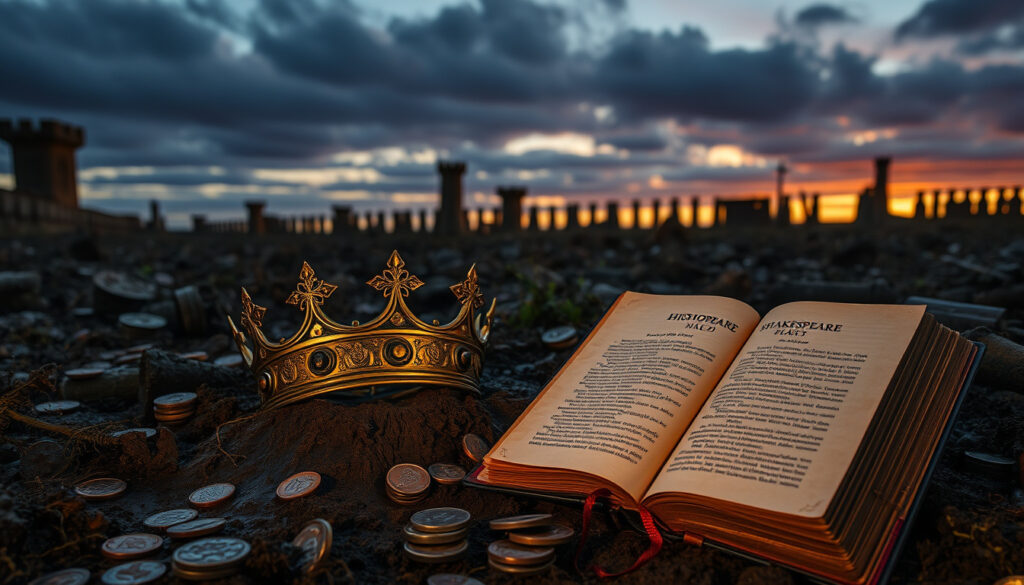
Richard III: History, Discovery, and Shakespeare’s Villain
Shakespeare gave him a crooked spine and a soul black enough to fill a tragedy. But the real Richard III — the last Plantagenet king, killed at thirty-two on a muddy Leicestershire field — is a far more complicated figure. With his skeleton unearthed beneath a Leicester car park in 2012 and identified by DNA, we now have hard evidence to weigh against the myth.
Reign: 26 June 1483 – 22 August 1485 ·
Born: 2 October 1452, Fotheringhay Castle ·
Died: 22 August 1485, Battle of Bosworth (age 32) ·
Burial: Originally Greyfriars, Leicester; reinterred at Leicester Cathedral in 2015 ·
Skeleton discovered: 2012 under a car park in Leicester ·
Shakespeare play: ‘Richard III’ written around 1592
Quick snapshot
- Skeleton found under Leicester car park in 2012 University of Leicester
- Identified via DNA and radiocarbon dating University of Leicester
- Reinterred at Leicester Cathedral in 2015 BBC News
- Shakespeare’s villainous portrayal EBSCO
- Accused of murdering the Princes in the Tower BBC Bitesize
- Debate over his physical deformity and character EBSCO
- Inspires historical and literary analysis BBC Bitesize
- DNA links to modern descendants King Richard III Visitor Centre
- Continues to polarize opinion Richard III Society American Branch
Six key facts about Richard III, from birth to rebutial:
| Attribute | Details |
|---|---|
| Full Name | Richard Plantagenet |
| Dynasty | House of York |
| Predecessor | Edward V (his nephew) |
| Successor | Henry VII (Tudor) |
| Spouse | Anne Neville |
| Children | Edward of Middleham (died young) |
Why Was Richard III Controversial?
Richard’s 26-month reign was one of the most polarising in English history. To his Tudor successors — and to William Shakespeare — he was a monster. But the historical record suggests a more nuanced picture.
Shakespeare’s Richard murders his way to the crown with relish. The real Richard passed laws in Parliament that helped commoners and founded the College of Arms. One man, two radically different portraits — and the truth lies somewhere between.
What Was Richard III Accused Of?
- Usurping the throne from his nephew Edward V — a boy of twelve — in June 1483.
- Ordering the murder of the Princes in the Tower (Edward V and his brother Richard of Shrewsbury), who vanished after Richard took power. No definitive evidence exists, but suspicion has never died.
- Being a physically deformed tyrant, as dramatised by EBSCO (literary research database). Shakespeare’s play — written around 1592 — depicts him as a “poisonous bunch-backed toad.”
What Is the Tragic Flaw of Richard III?
In the play, Richard’s insatiable ambition — his refusal to stop clawing for power — is the engine that destroys him. BBC Bitesize (educational resource) describes the character as a “cold-blooded villain” whose evil is both his weapon and his downfall. Whether the historical Richard had the same fatal hunger is another question.
The implication: the controversy around Richard III is really a drama about how history gets written. The Tudors needed a villain to legitimise their own dynasty, and Shakespeare gave them one so vivid that the real man — a competent if ruthless administrator — has been almost lost.
How Did They Know Richard III Was Buried in a Car Park?
The short answer: a combination of historical detective work, determined archaeology, and mitochondrial DNA. Here’s how it happened.
What archaeological evidence was found?
- In 2012, the University of Leicester (lead archaeological institution) excavated the site of the former Greyfriars friary — now a council car park. They found a male skeleton with severe scoliosis (a curved spine, not a hunchback) and multiple perimortem wounds.
- The skeleton’s skull showed a large hole consistent with a halberd or sword blow. Pelvic wounds suggested a blade thrust through the buttock — possibly a humiliation wound after death.
- Radiocarbon dating narrowed the death to the mid-to-late 15th century, aligning with the Battle of Bosworth in 1485.
How was DNA used to confirm identity?
- The skeleton’s mitochondrial DNA — passed through the maternal line — matched Michael Ibsen, a Canadian-born furniture maker whose mother was a direct descendant of Richard’s sister Anne of York. The match was reported as 99.999% probability by King Richard III Visitor Centre (Leicester-based heritage site).
- Two further maternal-line descendants later came forward, providing additional confirmation.
The pattern: this wasn’t guesswork. It was a textbook example of modern forensic archaeology — start with the historical record, map the lost building, dig, find the body, test the DNA, then lay the king to rest in Leicester Cathedral on 26 March 2015.
The skeleton’s DNA and radiocarbon analysis, cross-referenced with historical records of the Greyfriars site, produced an identification with near-certainty. The University of Leicester’s forensic team documented each step, making the case a benchmark for archaeological science.
How Was Richard III Killed?
We know the date: 22 August 1485. We know the place: Bosworth Field, Leicestershire. But the skeleton tells a more intimate story of how a king died in combat.
- Skull wounds: analysis by the University of Leicester (osteology and archaeology experts) revealed at least two serious blows to the head — one likely from a sword, another from a halberd. The fatal wound was a blade that penetrated the base of the skull.
- Pelvis: a stab wound through the right buttock suggests a weapon thrust upward, possibly as Richard’s body was stripped or dragged. This matches contemporary accounts that his corpse was thrown over a horse and displayed.
- Total of nine wounds: the skeleton bears nine injuries, consistent with death in a dense melee rather than an execution.
The catch: for all the brutality, Richard fought to the end. The skeleton shows no defensive wounds on forearms — he went down fighting.
Is Queen Elizabeth a Descendant of Richard III?
Not directly, but the genealogical path weaves through the same tree. Queen Elizabeth II — and now King Charles III — are descended from Elizabeth of York, Henry VII’s wife and the daughter of Edward IV (Richard’s brother). That makes Richard a great-uncle of Henry VIII, but not a direct ancestor of the modern royal line.
Is Benedict Cumberbatch related to King Richard III?
- Yes. The actor is a third cousin, twice removed, sharing a common ancestor: John of Gaunt, the 14th-century Duke of Lancaster. The connection was confirmed during the research for the documentary Richard III: The King in the Car Park.
- At Richard’s reburial service in Leicester Cathedral in 2015, Cumberbatch read a poem written by the Poet Laureate Carol Ann Duffy — a fitting tribute from a living relative.
Why this matters: the genetic links don’t just satisfy curiosity. They prove that Richard’s DNA can be traced through centuries, and they keep the conversation about his reputation alive — even a Sherlock Holmes actor can claim the last Plantagenet as kin.
Was Richard III a Good or Bad King?
That question has divided historians for 500 years. The evidence from his short reign is mixed, and the answer depends on which set of facts you weigh most heavily.
Was Richard III faithful to his wife?
- Richard married Anne Neville in 1472. Their only child, Edward of Middleham, died at age ten in 1484. There is no contemporary evidence that Richard was unfaithful or that the marriage was troubled — unlike many royal unions of the era.
- Some later rumours claimed he wanted to remarry after Anne’s death in 1485, but these came from Tudor propagandists. The Richard III Society American Branch (historical society dedicated to reassessing his reputation) argues that the sources are unreliable.
Bottom line: Richard III was neither the monster of Shakespeare’s stage nor the saint some revisionists claim. For modern readers, the lesson is clear: treat every source — from the Tudors to the present — as carrying its own agenda. Use the archaeological evidence as your anchor.
Historians continue to debate his effectiveness as a ruler, but the physical evidence from his skeleton now grounds that debate in something more solid than propaganda.
Timeline of Richard III’s Life, Death and Discovery
- 2 October 1452: Richard born at Fotheringhay Castle Wikipedia.
- 1483: Becomes Lord Protector after Edward IV’s death Wikipedia.
- June 1483: Assumes throne as Richard III Wikipedia.
- 22 August 1485: Battle of Bosworth; Richard killed Wikipedia.
- 1592-1593: Shakespeare’s play Richard III written EBSCO.
- 2012: Skeleton discovered under car park in Leicester University of Leicester.
- 26 March 2015: Reburial at Leicester Cathedral, with the coffin lowered into a vault personally sealed by BBC News (UK national news).
Now that you have the full story, the question of Richard III is no longer just about a Shakespearean villain. For anyone reading Tudor history, the choice is clear: believe the playwright, or trust the bones — but don’t do both uncritically.
Clarity: What we know and what remains debated
Confirmed facts
- Richard III was killed at Bosworth Field on 22 August 1485 Wikipedia.
- His skeleton was found in Leicester in 2012 with scoliosis University of Leicester.
- He was the last Plantagenet king Wikipedia.
What’s unclear
- Whether he ordered the murder of the Princes in the Tower.
- The exact nature of his relationship with Anne Neville.
- How much of Shakespeare’s portrayal is accurate.
- Whether Richard III was a good or bad king in absolute terms.
What the experts say
“The discovery of Richard III’s skeleton is the most exciting archaeological development of our time — it gives us a direct window into the man behind the myth.”
— University of Leicester archaeologist University of Leicester (lead archaeological institution)
“Shakespeare’s Richard is a stage villain; the historical Richard was a competent medieval king who ruled for 26 months and tried to govern well.”
— Historian, BBC Bitesize (educational resource)
“The DNA match made the identification of the skeleton 99.999% probable. That’s as close to certainty as you get in historical science.”
— King Richard III Visitor Centre (Leicester-based heritage site)
For students of English history, the story of Richard III is a powerful reminder: sources tell you as much about their authors as they do about their subjects. The car park skeleton let us see past Shakespeare — but only just.
en.wikipedia.org, successtutoring.com.au, youtube.com, churchmonumentssociety.org
For a deeper look at how the archaeological find reshaped our understanding of the king, read about the truth behind Shakespeares villain.
Frequently asked questions
Where was Richard III buried after his death?
He was originally buried without ceremony in the Greyfriars friary in Leicester. After the Dissolution of the Monasteries, the site was built over and eventually became a car park.
Did Richard III really have a hunchback?
No. The skeleton revealed scoliosis — a curvature of the spine — which would have made one shoulder higher than the other, but not a hunchback. Shakespeare exaggerated the deformity for dramatic effect.
What happened to the Princes in the Tower?
They disappeared after Richard took the throne. No body has ever been found, and the mystery remains unsolved. Most historians believe they were murdered, but by whom — Richard or someone else — is contested.
Who succeeded Richard III as king?
Henry Tudor, Earl of Richmond, became Henry VII after defeating Richard at Bosworth. He founded the Tudor dynasty and married Elizabeth of York, uniting the houses of York and Lancaster.
Was Richard III involved in the Wars of the Roses?
Yes. He fought for the Yorkist side throughout the conflict, which was a series of civil wars between the Houses of York and Lancaster for the English throne.
What is the Richard III Society?
It is a historical society founded in 1924 dedicated to reassessing Richard’s reputation. The society funded much of the research leading to the car park excavation. Richard III Society American Branch
Can I visit Richard III’s grave?
Yes. Richard III was reinterred in Leicester Cathedral in 2015. His tomb, made of Swaledale fossil stone, is on public view in the cathedral. The King Richard III Visitor Centre in Leicester tells the discovery story. Leicester Cathedral (place of reburial)
These questions represent the most common curiosities about a king whose life and legacy remain subjects of intense interest.
More related posts
 Seapuri Scalp Serum – Dandruff Relief and Hair Growth
 Kmart Bass Hill – Hours, Address, Phone & Directions
 Iga Swiatek: Biography, Career, Relationship & Doping Case
 David Schwimmer: Net Worth, Family, and Life After Friends
 Nancy Reagan: Her Life, Controversies, and Enduring Legacy
 Ginger Spice: Why Geri Halliwell Got Her Nickname
 Wednesday Addams: Why Jenna Ortega Isn’t Leaving | Facts
 Find an Obituary for a Specific Person – Step-by-Step Guide
