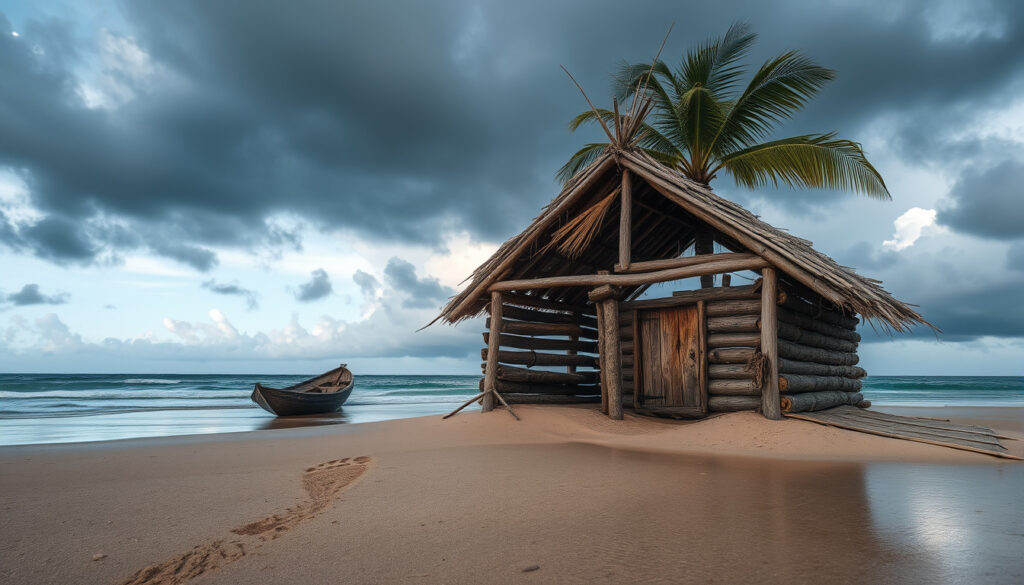
Robinson Crusoe: Summary, True Story, Moral, and Reading Guide
Few novels have shaped the idea of being stranded like Robinson Crusoe. Published in 1719, Daniel Defoe’s tale of a shipwrecked man surviving alone for 28 years has become the blueprint for every castaway story that followed. This guide separates the novel’s plot from its real-world inspiration, and answers the practical questions readers and parents actually ask.
First published: 25 April 1719 ·
Author: Daniel Defoe ·
Genre: Adventure novel, realistic fiction ·
Years stranded: 28 years, 2 months, 19 days
Quick snapshot
- First published 25 April 1719 (Cove Collective academic chronology)
- Written by Daniel Defoe (Britannica reference publisher)
- A fictional work inspired by Alexander Selkirk’s story (HISTORY factual media)
- Crusoe’s exact number of children after returning to England is not explicit in the text
- The age at which the original text is appropriate varies: abridged versions suit 12+, original text is more suitable for 16+
- Crusoe shipwrecked in September 1659 (SparkNotes literature study guide)
- Rescued in December 1687 after 28 years, 2 months, 19 days (SparkNotes literature study guide)
- Over 30 film adaptations continue to reinterpret the story
- Modern readers increasingly choose annotated or abridged editions for accessibility
Eight key details in one view, grounding the novel in its facts:
| Attribute | Value |
|---|---|
| Full title | The Life and Strange Surprizing Adventures of Robinson Crusoe, of York, Mariner |
| Author | Daniel Defoe |
| Year of publication | 1719 |
| Number of pages (standard edition) | Approximately 320 |
| Original language | English |
| Protagonist | Robinson Crusoe |
| Setting | Deserted island near the coast of South America |
| Time stranded | 28 years, 2 months, and 19 days |
What is the story of Robinson Crusoe?
Plot summary
Young Robinson Crusoe, a middle-class Englishman from York, defies his parents’ wishes and goes to sea (Britannica reference publisher). His early adventures include capture by pirates, a period of slavery, and an escape that leads him to Brazil, where he becomes a successful plantation owner. The turning point comes when he joins a voyage to Africa to acquire enslaved people for his plantation — a decision that ends in shipwreck. Crusoe is the sole survivor, washed ashore on a deserted island near the coast of South America (SparkNotes literature study guide).
Key events on the island
Crusoe salvages tools, food, weapons, and supplies from the wrecked ship, creating a fortified shelter and learning to hunt, farm, and make pottery (OwlEyes literary annotation platform). Over the years he encounters cannibals, rescues a native man he names Friday, and contends with mutineers who arrive on the island (LitCharts literature study resource).
Rescue and return
After 28 years, 2 months, and 19 days, a passing English ship helps Crusoe regain passage home. He returns to England a wealthy man, his Brazilian plantation having been maintained in his absence (Britannica reference publisher).
Was Robinson Crusoe a true story?
Historical inspiration
No, Robinson Crusoe is a work of fiction, not a true story. However, the novel was inspired by the real-life experience of Alexander Selkirk, a Scottish sailor marooned on a Pacific island for four years (HISTORY factual media). Selkirk’s survival — hunting goats, using salvaged tools, and living in isolation — provided Defoe with a compelling real-world reference point.
Relation to Alexander Selkirk
Selkirk’s story was widely known in England after his rescue in 1709. Defoe transformed Selkirk’s four-year ordeal into a 28-year fictional saga, adding the character of Friday, the cannibal encounters, and the mutineer subplot. The core question — what would happen to a single person abandoned in isolation — remained the same (HISTORY factual media).
Differences between fiction and reality
Selkirk was a privateer, not a middle-class Englishman. He chose to be left ashore voluntarily after a quarrel with his captain, and he was rescued after four years — not 28. Defoe’s version added the survival narrative’s moral framework: Crusoe’s isolation becomes a spiritual journey of repentance and divine providence (Britannica reference publisher).
The more “true” the story feels — with its realistic detail and precise dates — the more it obscures its fictional core. Readers today often assume Crusoe was real because the novel invented the very conventions of realistic fiction.
Is Robinson Crusoe a hard read?
Reading level and language difficulty
The original text is written in early 18th-century English, which means modern readers face long sentences, archaic vocabulary (“surprizing,” “mariner”), and a narrative pace that feels slow by contemporary standards (Britannica reference publisher). The reading level of the original text is roughly equivalent to college level in terms of syntactic complexity.
Modern readability
Most school-age readers today encounter the story through abridged editions, which shortens sentences, modernizes vocabulary, and cuts the longer theological passages. For an adult reader comfortable with occasional dictionary use, the original is manageable but requires patience (Trinity College Library Cambridge academic library).
Abridged editions for younger readers
If you’re a parent or educator, the abridged versions — available from Oxford, Puffin, and Dover — are appropriate for readers aged 12 and up. The original text is better suited for ages 16 and older, due to its dense prose and themes of slavery, violence, and colonialism.
Parents choosing books for 12-year-olds face a genuine trade-off: the abridged version delivers the iconic survival plot in accessible language but strips the colonial context that makes the novel historically significant. The original text preserves that context but demands a mature reader.
What is the moral story of Robinson Crusoe?
Themes of repentance and providence
The novel’s moral framework is explicitly religious. Crusoe’s isolation is framed as divine punishment for his disobedience to his parents, and his survival becomes a journey of repentance and spiritual awakening. He thanks God daily and reads the Bible regularly (Britannica reference publisher).
Colonial and imperial undertones
The story also reflects the colonialist attitudes of Defoe’s era. Crusoe claims ownership of the island, imposes his language and religion on Friday, and treats the island as a domain to be mastered. For modern readers, this is the most morally complicated layer of the book (LitCharts literature study resource).
Self-reliance and human ingenuity
At its surface, the moral is about individual resourcefulness: Crusoe does not simply wait to be rescued — he builds, farms, hunts, and creates a life from nothing. This theme of self-reliance is the reason the novel has been adapted as a survival story across so many cultures (OwlEyes literary annotation platform).
What is the main message of Robinson Crusoe?
Individualism and self-reliance
The most dominant message is that an individual, through reason, hard work, and perseverance, can overcome extreme adversity. Crusoe’s story celebrates the Enlightenment ideal of the self-made man.
Colonialism and civilization
Crusoe’s relationship with Friday also carries a clear message about the superiority of European civilization as Defoe’s era understood it. Friday learns English, converts to Christianity, and serves Crusoe. Modern critics read this as the novel’s most problematic element (LitCharts literature study resource).
Religious faith and redemption
For Defoe, the story’s true message was spiritual. Crusoe’s isolated island becomes a space for divine conversation, and his eventual rescue is framed as God’s reward for faith and repentance. Without this layer, the novel loses its intended moral weight (Britannica reference publisher).
Timeline: Key dates in the novel
- 1650s — Robinson Crusoe is born in York, England.
- 1660s — Crusoe defies his parents and goes to sea for the first time (Britannica reference publisher).
- September 1659 — Shipwrecked on a deserted island near South America (SparkNotes literature study guide).
- September 1659 – December 1687 — Survives on the island for 28 years, 2 months, and 19 days.
- December 1687 — Rescued by a passing ship and returns to England (Britannica reference publisher).
- 25 April 1719 — Publication of the novel by Daniel Defoe (Cove Collective academic chronology).
Confirmed facts and open questions
Confirmed facts
- Robinson Crusoe was first published on 25 April 1719 (Cove Collective academic chronology).
- The novel is fiction, not a true story (HISTORY factual media).
- Daniel Defoe was imprisoned for seditious libel in 1703.
- The novel is often credited as marking the beginning of realistic fiction in English literature (Britannica reference publisher).
What’s unclear
- The exact number of children Crusoe had upon his return to England is not clearly stated; some sources say three.
- The age-appropriate threshold for reading the original text is subjective — generally 12+ for abridged, 16+ for the original.
Notable quotes
“The Life and Strange Surprizing Adventures of Robinson Crusoe, of York, Mariner”
— Daniel Defoe, full novel title
“Robinson Crusoe is an English adventure novel by Daniel Defoe, first published on 25 April 1719. It is often credited as marking the beginning of realistic fiction.”
— Britannica reference publisher
“Robinson Crusoe, a novel by Daniel Defoe, tells the story of Robinson Crusoe, a young man who defies his parents and leaves his comfortable home.”
— Britannica reference publisher
“The book is based in part on the experiences of Alexander Selkirk, a Scottish sailor marooned for four years.”
— HISTORY factual media
en.wikipedia.org, cs.wikipedia.org, study.com, pt.wikipedia.org, owleyes.org
For a broader look at the novel’s moral and factual background, you might consult this detailed summary of Robinson Crusoe from another literary site.
Frequently asked questions
What is the main conflict in Robinson Crusoe?
The central conflict is man versus nature: Crusoe must survive alone on a deserted island with limited resources. An internal conflict also runs throughout: his struggle between disobedience to his parents and his restless desire for the sea.
How does Robinson Crusoe find food on the island?
Crusoe salvages food from the wrecked ship, learns to hunt goats, plants crops like barley and rice, and fishes. He also learns to make pottery, baskets, and tools over the course of his stay (OwlEyes literary annotation platform).
Does Robinson Crusoe have a family?
The novel does not clearly state Crusoe’s family after returning to England. Some interpretations suggest he had three children (two sons and one daughter) but the text is ambiguous on this point.
What is the significance of Friday in the novel?
Friday is a native man Crusoe rescues from cannibals. He becomes Crusoe’s companion, servant, and convert. Their relationship is central to the novel’s themes of colonialism, friendship, and civilization versus nature (LitCharts literature study resource).
How long was Robinson Crusoe stranded?
He was stranded for exactly 28 years, 2 months, and 19 days, from September 1659 to December 1687 (Britannica reference publisher).
What is the original language of Robinson Crusoe?
The novel was originally written in English. The full original title is The Life and Strange Surprizing Adventures of Robinson Crusoe, of York, Mariner.
Is there a movie adaptation of Robinson Crusoe for children?
Yes, several adventure-friendly adaptations exist, including the 1954 film starring Daniel O’Herlihy, and a 1997 film starring Pierce Brosnan. Animated versions and TV adaptations also exist for younger audiences.
What is the opening line of Robinson Crusoe?
“I was born in the year 1632, in the city of York, of a good family, though not of that country, my father being a foreigner of Bremen, who settled first at Hull.”
Related reading
- The Bethany Hamilton Shark Attack: Survival and Mystery — another story of individual survival against overwhelming odds
- Queen Charlotte: The Real Story Behind the Bridgerton Prequel — separating historical fact from fictional narrative
Editor’s note: This guide was written with a focus on factual accuracy and practical reader guidance. For educators and parents, the key takeaway is to choose an edition appropriate to your reader’s age and comfort with colonial-era themes. For the general reader, Robinson Crusoe remains a fascinating window into how the modern novel began — and how one man’s isolation became a genre-defining story. The implications for anyone recommending this book: pair a well-chosen edition with honest conversation about its time, its limitations, and its enduring power.
More related posts
 Robin Wright: Biography, Career, and Personal Life
 Alex Karp: Biography, Ethnicity, Net Worth & Controversies
 Bruce Lee: Death Cause, IQ, Net Worth, and Myth Busting
 Ivan the Terrible: Biography, Reign, and Lasting Legacy
 Medical Malpractice Lawyer – Complete Hiring Guide
 Wake Up: Meaning, Definitions, Synonyms & Cultural Impact
 Bhad Bhabie: Cancer, OnlyFans Earnings & Personal Life
 Sean Connery: Cause of Death, Net Worth, Career and Relationships
