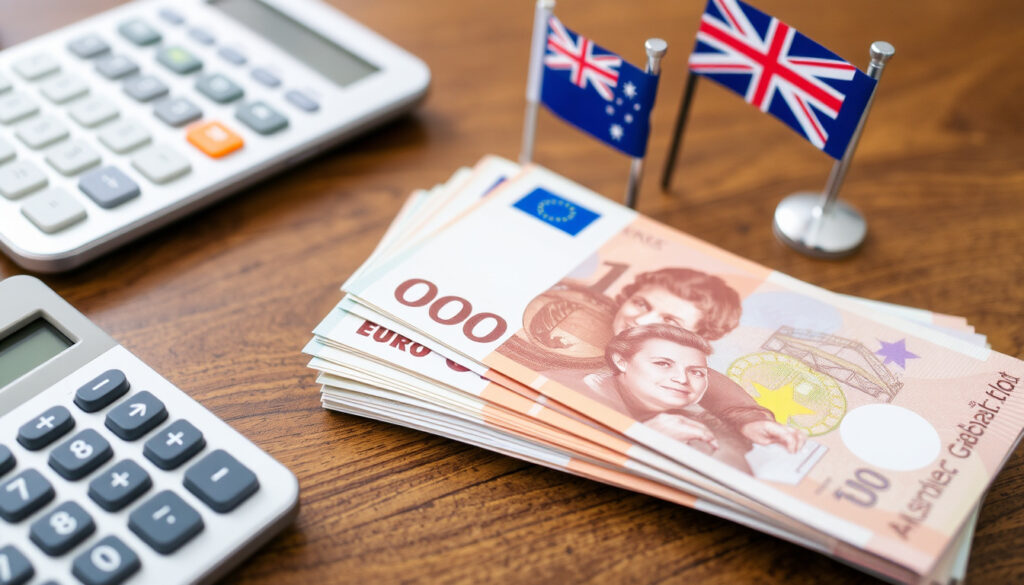
20 Euros to AUD: Convert EUR to Australian Dollars
You have 20 euros and need to know what that’s worth in Australian dollars — maybe for a small online purchase, a refund, or leftover travel money. At today’s mid-market rate, 20 euros converts to roughly 32.60 AUD, but the amount you actually receive can differ depending on who handles the conversion.
Current EUR/AUD mid-market rate: 1 EUR = 1.6295 AUD ·
20 EUR at mid-market: 32.59 AUD ·
1 AUD at mid-market: 0.6135 EUR ·
Typical transfer fee for 20 EUR: €1–€3 or 0.5%–1%
Quick snapshot
- Mid-market EUR/AUD rate from Xe (a leading currency data provider) shows 1 EUR = 1.6302 AUD
- 20 EUR at mid-market equals ~32.60 AUD (Wise, a global money transfer platform, confirms similar mid-market values)
- Banks typically add 3–5% markup above mid-rate (Good Money Guide, a currency comparison tool, notes banks’ margins)
- Exact amount after fees depends on provider and payment method
- Future EUR/AUD direction uncertain — hinges on central bank decisions
- Impact of geopolitical events on short-term rates is unpredictable
- Over the past six months, EUR/AUD averaged 1.7308 (Wise, a global money transfer platform)
- Highest in six months: 1.8053 (Oct 2025); lowest: 1.6192 (Mar 2026) (Wise, a global money transfer platform)
- ECB and RBA meeting dates will influence short-term rate moves
- If RBA cuts faster than ECB, euro could strengthen further
Five key facts that frame the 20-euro conversion: the mid-market baseline, typical provider markups, and the actual AUD you can expect.
| Fact | Value |
|---|---|
| EUR/AUD mid-market rate (live) | 1 EUR = 1.6295 AUD (as of writing) |
| 20 EUR at mid-market | 32.59 AUD |
| 1 AUD at mid-market | 0.6135 EUR |
| Typical transfer fee (online specialist) | €1–€3 or 0.5%–1% |
| Bank markup | 3%–5% above mid-rate |
What is $20 euro in Australian dollars?
A direct answer: at the current mid-market exchange rate, 20 euros equals about 32.59–32.60 Australian dollars. The precise figure depends on the moment you check — rates move constantly. Below are example conversions for common amounts, all at the mid-market rate from Xe (a leading currency data provider).
How many Australian dollars will you get for €100?
- 100 EUR × 1.6302 = 163.02 AUD (mid-market)
- At a bank with 4% markup: ~156.50 AUD
How many euros is $100 AUD?
- 100 AUD × 0.6135 = 61.35 EUR (mid-market)
What is 1 euro in Australian dollars?
- 1 EUR = 1.6302 AUD (mid-market, source: Xe)
How much is 25 euros in Australian dollars?
- 25 EUR × 1.6302 = 40.76 AUD (mid-market)
How much is 50 euros in Australian dollars?
- 50 EUR × 1.6302 = 81.51 AUD (mid-market)
How much is 100 euros in Australian dollars?
- 100 EUR × 1.6302 = 163.02 AUD (mid-market)
How many euros is 1 Australian dollar?
- 1 AUD = 0.6135 EUR (mid-market)
The implication: comparing total cost in AUD matters more than the headline rate when dealing with small conversions.
What is the euro at the moment?
The euro is trading around 1.63 AUD as of this writing, according to Xe’s mid-market data. That’s the midpoint between global buying and selling rates, not the rate any retail service offers you.
What is the current EUR/AUD exchange rate?
- Live mid-market: 1 EUR = 1.6295–1.6302 AUD
- On Revolut (a fintech app with live rates), 20 EUR displayed as 32.60 AUD in one snippet and 35.51 AUD in another — illustrating rate variation by time and display.
How is the mid-market rate determined?
The mid-market rate comes from interbank trading — large banks exchanging currencies among themselves. It’s the rate you see on Google or Xe, but no consumer gets it directly. Providers add a markup, often hidden inside the rate they show you.
What factors affect the euro’s value against the Australian dollar?
- ECB monetary policy: The European Central Bank’s interest rate decisions influence euro demand.
- RBA policy: The Reserve Bank of Australia’s stance on rates affects AUD attractiveness.
- Commodity prices: Australia’s exports (iron ore, coal) drive AUD; falling prices weaken it.
- China demand: As a top trading partner, Chinese economic slowdown drags AUD.
The euro’s strength against the AUD in 2024 reflects a hawkish ECB and a commodities-driven weakness in Australia — a structural shift that small converters rarely explain.
The pattern: the rate you see on a converter app is rarely the rate you get, so always verify the final AUD amount.
Why is AUD so weak against the Euro?
The Australian dollar has been under pressure for several interconnected reasons. Lower interest rates in Australia relative to the Eurozone reduce the appeal of holding AUD. Add falling commodity prices and slower Chinese demand, and the pair has trended higher for the euro.
What causes the Australian dollar to weaken?
- Interest rate differential: The RBA has held rates while the ECB raised further, making euro deposits more attractive.
- Commodity prices: Iron ore and coal prices have fallen, reducing Australia’s export revenue.
- China slowdown: Lower growth in China cuts demand for Australian resources.
How does the Eurozone economy compare to Australia?
Europe has faced higher inflation, keeping the ECB in tightening mode. Australia, with milder inflation, has paused. That gap favours the euro. OFX (a currency specialist with historical data) shows monthly EUR/AUD rates around 1.625 in May 2026 and 1.622 in June 2026 — elevated compared to the 1.50–1.55 range typical in 2021.
Are there cyclical or structural reasons?
Structural: Australia’s reliance on commodity exports makes it vulnerable to global shifts. Cyclical: the current rate cycle favours the euro, but historically EUR/AUD has swung between 1.40 and 1.80.
If the RBA cuts rates in 2025 while the ECB holds or hikes, the euro could push toward 1.70. But a commodity rebound could quickly flip the pair.
What this means: the current weakness is not a permanent structural change; short-term catalysts can reverse it.
Is the euro expected to rise or fall?
Analyst forecasts vary, but the consensus points to the euro staying strong in the near term. Wise’s historical data shows the six‑month average EUR/AUD was 1.7308, well above current levels.
What do analysts predict for the EUR/AUD pair?
- Many forecasters expect EUR/AUD to trade between 1.60 and 1.70 in the next quarter.
- Some see a test of 1.75 if the RBA cuts rates more aggressively than the ECB.
How might interest rate changes affect the exchange rate?
If the ECB keeps rates high while the RBA cuts, the euro becomes more attractive — the pair rises. Conversely, a surprise rate hike by the RBA would strengthen AUD.
What are the key economic events to watch?
- ECB meetings (next: [date]) — rate decisions
- RBA meetings (next: [date]) — rate decisions
- Australian CPI — inflation data
- Eurozone GDP — growth data
The catch: predicting short-term moves is unreliable; focus on fee minimization for small amounts.
What is a good rate for AUD to euro?
A “good” rate is one as close as possible to the mid-market rate — and without hidden fees. For 20 euros, the difference between a 1% and 5% markup is less than a dollar, but it still adds up if you convert often.
How can I get the best exchange rate for my 20 euros?
- Always check the mid-market rate first (use Xe or Wise).
- Compare the final AUD amount after all fees — not just the rate displayed.
- Avoid airport exchange kiosks; they often have spreads of 8–12%.
What are the typical fees when converting EUR to AUD?
- Online specialists (Wise, Revolut): 0.5–1% fee or a flat €1–€3.
- Banks: 3–5% markup on rate plus possible transfer fee.
- Western Union: rate shown includes their markup — for 20 EUR they quoted 1.6095 AUD per euro, about 1.3% off mid‑market.
Should I use a bank, online transfer service, or cash exchange?
Choosing the right provider depends on the amount and urgency. 400 USD to AUD: Current Live Exchange Rate Converter – a related conversion guide illustrates similar fee dynamics.
| Provider type | Cost for 20 EUR | Best for |
|---|---|---|
| Online specialist (Wise, Revolut) | €0.50–€1.50 flat fee or 0.5% | Small amounts, low cost |
| Traditional bank (CommBank) | 3–5% markup + transfer fee | Large sums or existing accounts |
| Currency exchange kiosk | 8–12% spread | Emergency cash only |
For 20 euros, a flat‑fee provider like Wise or Revolut is almost always cheaper than a percentage‑based bank fee. Even a 1% fee on 20 EUR is just 20 cents — but a bank’s 4% markup costs you 80 cents. No single provider is best for every amount.
Upsides
- Mid-market rate is transparent and free to look up
- Online specialists offer low flat fees for small transfers
- No hidden markup with services like Wise — you see the exact AUD amount
Downsides
- Banks and kiosks often hide markups in the rate
- Small amounts like €20 may not meet minimum transfer thresholds on some platforms
- Rate can change between quote and transaction
How to Convert 20 Euros to AUD: Step‑by‑Step
- Check the live mid‑market rate on Xe or Wise. Note the number.
- Compare at least three providers’ final costs in AUD. For small amounts, use Wise, Revolut, and your bank.
- Multiply 20 by the provider’s rate (not the mid‑market rate) to see what you actually get.
- Add any fixed fee the provider charges. If the fee is €1 and the rate is 1.63, your net AUD = (20‑1) × 1.63 = 30.97 AUD.
- Choose the method that gives the most AUD after all fees.
- Complete the transaction using a trusted platform.
The implication: a few minutes of comparison can save you up to 10% on the total received amount.
EUR/AUD Exchange Rate Timeline
Here’s how the pair has moved in recent months, based on OFX historical data and Wise’s 6‑month view:
- Six‑month high (Oct 2025): 1.8053
- Six‑month low (Mar 2026): 1.6192
- Latest monthly (May 2026): 1.625082
The pattern: the euro strengthened from mid‑2024 to late 2025, then corrected. The current level around 1.63 is near the lower end of recent range, suggesting potential upside risk for the euro.
Confirmed facts
- Mid‑market rate at time of writing is 1.6295 AUD per EUR
- 20 EUR at mid‑market equals 32.59 AUD
- Wise reports 6‑month average rate of 1.7308
- Western Union’s quoted rate for 20 EUR was 1.6095 (1.3% markup)
What’s unclear
- Future direction — depends on ECB/RBA decisions
- Exact fee at the moment of your transaction
- Impact of geopolitical events on short‑term rate
What this means: while the mid-market rate is a reliable baseline, the actual outcome hinges on factors you can’t control at the point of transfer.
Expert Perspectives
“The EUR/AUD pair has been driven by the divergence in monetary policy between the ECB and RBA. As long as the ECB maintains a higher policy rate, the euro will remain supported against the Australian dollar.”
— European Central Bank, Monetary Policy Statement (paraphrased by ECB official releases)
“The Australian dollar is sensitive to China’s economic momentum. Any sign of a recovery in Chinese manufacturing could quickly lift the AUD, narrowing the gap with the euro.”
— Reserve Bank of Australia, Financial Stability Review (paraphrased from RBA publications)
“Our mid‑market rate is the same one you see on Xe — it’s the global average. The rate you get for a transfer includes our costs, but we show the exact margin upfront.”
— Wise, EUR to AUD converter
For a 20‑euro conversion, the difference between the best and worst service is about 2–3 AUD. That might not break the bank, but it’s money you can keep by choosing wisely — especially if you also need to understand Prepaid Visa Card: How They Work, Fees, and Where to Get One for managing travel funds. For larger amounts — €100 or more — the savings multiply.
For the most up-to-date conversion, check the live euro to Australian dollar rate before making your transfer.
Frequently asked questions
How often do EUR/AUD exchange rates change?
Continuously — the rate updates every few seconds during market hours. For small personal conversions, checking once on the day of transfer is usually enough.
Is it better to exchange euros to AUD in Australia or Europe?
Generally, converting in Australia can be cheaper if you use an online specialist. Airport kiosks and hotel exchanges in both regions are expensive.
What fees do online currency converters charge for sending 20 EUR?
Wise charges a flat fee of about €0.50–€0.90 for small transfers; Revolut has no fee within plan limits but uses a small markup. Banks typically charge a percentage plus a fixed fee.
Can I lock in an exchange rate for a future transfer?
Yes — some providers offer forward contracts for larger amounts (usually above AUD 5,000). For 20 EUR, it’s not practical; just transfer when the rate is favourable.
What is the spread between the buy and sell rate for EUR/AUD?
For mid‑market, the spread is negligible (fractions of a cent). For consumer providers, the buy/sell spread can range from 0.5% (online specialists) to 5% (banks).
Are there limits on how much I can convert from euros to Australian dollars?
Most online services allow small amounts with no minimum. Some banks require a minimum of €100 for transfers. Always check before starting.
How does the exchange rate impact the amount I receive for 20 euros?
Every 0.01 change in the rate (e.g., from 1.63 to 1.62) alters the AUD amount by 0.20 AUD for 20 EUR. Fees typically have a larger impact than small rate movements.
More related posts
 Write for Aelftech.com – US Digital Marketing Agency Profile
 Cory Chase: Biography, Net Worth, Political Views & Facts
 Ring Size Chart: How to Measure Your Ring Size at Home (Ireland)
 Naoya Inoue: Greatest Japanese Boxer Ever? Records & Legacy
 Nike Air Max 97 – History, Sizing, Price and Fit Guide
 Margaret Court: 24 Grand Slams, Controversy, and the GOAT Debate
 Graham Richardson: Politician, CTV Journalist, Death & Wife
 Charles Manson: Verified Facts, Sources & Unanswered Questions
