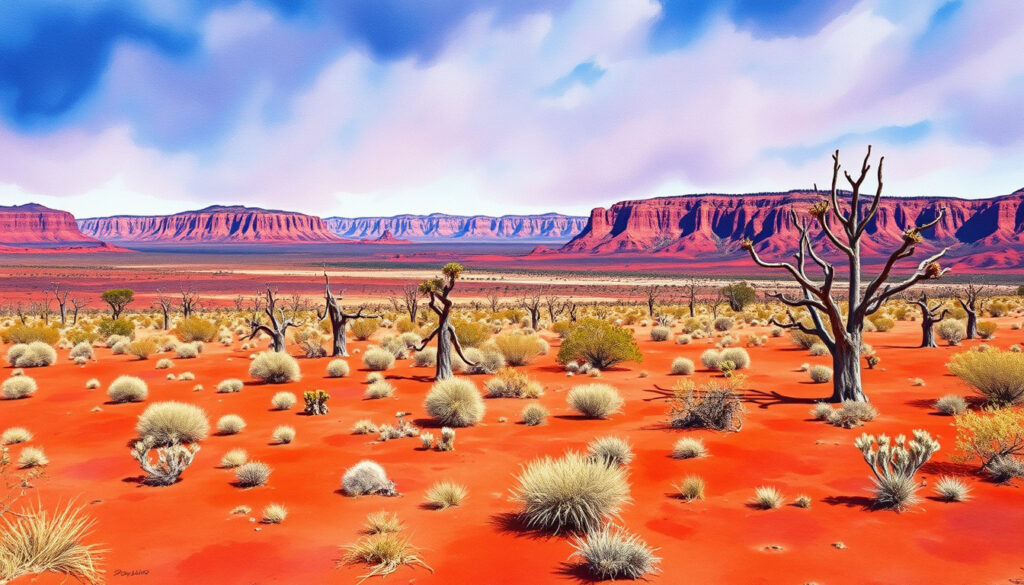
Albert Namatjira: Biography, Artworks & Legacy
Few artists have changed how a nation sees its own landscape quite like Albert Namatjira. By the time he died in 1959, the Arrernte watercolourist had painted thousands of Central Australian scenes that became icons of Australian art.
Born: 28 July 1902, Hermannsburg, Northern Territory · Died: 8 August 1959, Alice Springs, Northern Territory · Known for: Watercolour landscapes · Art movement: Hermannsburg School · Notable work: Mount Hermannsburg (1955)
Quick snapshot
- Full name: Albert Namatjira (Australian Dictionary of Biography (academic biography))
- Born: 28 July 1902 — Australian Dictionary of Biography (academic biography)
- Died: 8 August 1959 — Britannica Kids (educational reference)
- Nationality: Australian Aboriginal (Arrernte) (Australian Dictionary of Biography (academic biography))
- Medium: Watercolour (National Archives of Australia (government archive))
- Subject: Central Australian landscapes — National Archives of Australia (government archive)
- Movement: Hermannsburg School — Queensland Museum (state museum)
- Influence: Western art meets Arrernte tradition (National Archives of Australia (government archive))
- First Aboriginal Australian granted limited citizenship — National Portrait Gallery (cultural institution)
- Over 3,000 paintings produced (National Portrait Gallery (cultural institution))
- Works held in major galleries worldwide — National Archives of Australia (government archive)
- Family won compensation for copyright breaches — Allens (commercial law firm)
- Mount Hermannsburg (1955) — National Gallery of Australia (national institution)
- Ghost Gum, Central Australia (National Gallery of Australia (national institution))
- The Red Centre (National Gallery of Australia (national institution))
- MacDonnell Ranges series (National Gallery of Australia (national institution))
Eight facts, one pattern: Namatjira’s life is a story of artistic triumph and systemic injustice. The table below captures the essentials.
| Attribute | Detail |
|---|---|
| Full name | Albert Namatjira (birth name: Elea) |
| Birthplace | Hermannsburg Mission, Northern Territory — Australian Dictionary of Biography (academic biography) |
| Death | Alice Springs Hospital, 8 August 1959 — Britannica Kids (educational reference) |
| Spouse | Julinka (m. 1922) |
| Children | 10 (including Albert Namatjira Jr.) |
| Notable exhibition | First solo exhibition in Melbourne, 1945 — Benalla Art Gallery (regional gallery) |
| Art medium | Watercolour on paper |
| Estimated total works | Over 3,000 |
“He had an eye for the country that none of us could match — he saw colours in the desert that we didn’t know were there.”
— Rex Battarbee, mentor who introduced Namatjira to watercolour, as recorded by the Benalla Art Gallery (regional gallery)
Why is Albert Namatjira so important?
Albert Namatjira fundamentally changed how Australians saw their own continent. Before him, the red desert was considered barren; his watercolours revealed a luminous, sacred landscape. The National Archives of Australia (government archive) notes that he is “widely regarded as one of Australia’s most notable artists.”
Pioneering Aboriginal artist in Western art
- In 1957 he became the first Aboriginal or Torres Strait Islander person to receive limited Australian citizenship, according to the National Portrait Gallery (cultural institution).
- His work changed perceptions — white Australians began to see the Outback as beautiful rather than forbidding.
- He influenced an entire school of painting now called the Hermannsburg School, as documented by the Queensland Museum (state museum).
Cultural bridge between Arrernte and European traditions
Namatjira blended the Western watercolour technique he learned from Rex Battarbee with a deep, ancestral knowledge of Country. The National Portrait Gallery describes his style as “rooted in deep ancestral connection,” not merely European aesthetics. This fusion created a new visual language — one that spoke equally to Arrernte custodians and Melbourne gallerists.
What happened to Albert Namatjira?
His later years were tragic — arrested for a crime that was not a crime for white Australians, he was imprisoned and died soon after release.
His arrest and imprisonment
- In 1958 Namatjira was arrested for supplying alcohol to an Aboriginal person — an offence under the Northern Territory’s welfare laws.
- He was sentenced to six months in prison. The National Portrait Gallery notes that his life and career were “affected by prejudice and inequality.”
Later years and death
- After his release he was a broken man, suffering from heart disease.
- He died of heart failure on 8 August 1959 in Alice Springs Hospital, as recorded by Britannica Kids (educational reference).
Namatjira’s six-month sentence effectively ended his career — and his health. The same legal system that granted him citizenship in 1957 took his freedom a year later for an act that would have passed without notice for a white Australian.
The implication: legal status alone did not protect him from the racial double standards that governed the Territory.
What is Albert Namatjira most famous artwork?
Mount Hermannsburg (1955) is widely considered his masterpiece, but several other paintings define his legacy.
Mount Hermannsburg (1955)
- This watercolour depicts the mountain near his birthplace with extraordinary luminosity.
- It is held by the National Gallery of Australia (national institution) and is frequently cited as his finest work.
Other iconic paintings
- Ghost Gum, Central Australia and The Red Centre are equally revered.
- His MacDonnell Ranges series captures the spine of the country that raised him.
- The National Archives of Australia notes that his work was primarily watercolour landscapes of Central Australia.
The pattern: each painting renders a familiar outback landmark with a luminosity that forced viewers to see the desert anew.
Did Albert Namatjira have children and a family?
Yes — and his family’s fight for justice continues to make headlines.
His children and descendants
- He married Julinka in 1922 and they had ten children.
- His son Albert Namatjira Jr. also became a painter, continuing the family tradition.
- Many of his grandchildren and great-grandchildren still live in Central Australia.
Family legacy and compensation
- In 2019, his family won a decades-long compensation battle for unpaid royalties from the sale of his artworks.
- The law firm Allens (commercial law firm) represented them and secured a settlement — the amount remains confidential.
The 2019 settlement set a precedent for Indigenous artists and their estates: copyright is not automatically lost when a work is sold. For Aboriginal communities, it was a small step toward correcting decades of exploitation.
The catch: the confidential amount means the public will never know the full value of what was taken.
How much money did Albert Namatjira make?
During his lifetime Namatjira was one of Australia’s highest-earning artists — but he saw little of that money.
Earnings and financial exploitation
- His 1938 solo exhibition in Melbourne — 41 paintings — sold out, according to the Benalla Art Gallery (regional gallery).
- But dealers and middlemen pocketed most of the proceeds. By the 1950s he was effectively broke.
Compensation from Allens law firm
- The 2019 settlement, while confidential, acknowledged that his estate had been systematically underpaid.
- It remains a landmark case for Indigenous intellectual property rights in Australia.
Timeline
- 28 July 1902 — Born at Hermannsburg Mission, NT (Australian Dictionary of Biography (academic biography))
- 1922 — Married Julinka
- 1934 — Began painting watercolours under Rex Battarbee
- 1945 — First solo exhibition in Melbourne
- 1957 — Granted limited Australian citizenship (National Portrait Gallery (cultural institution))
- 1958 — Arrested for supplying alcohol to an Aboriginal person
- 8 August 1959 — Died of heart failure in Alice Springs (Britannica Kids (educational reference))
- 2019 — Family wins compensation from Allens (Allens (commercial law firm))
Confirmed facts vs. what’s unclear
Confirmed facts
- Born 28 July 1902 at Hermannsburg Mission (ADB)
- Arrernte artist known for watercolour landscapes (National Archives)
- Met Queen Elizabeth II in 1954 during her Royal Tour (National Portrait Gallery)
- Died 8 August 1959 in Alice Springs (Britannica)
- Family received 2019 compensation for copyright breaches (Allens)
What’s unclear
- Exact total value of his estate or individual painting sales in today’s dollars
- Specific number of paintings he created (estimates range 2,000–3,000)
- Full details of the compensation settlement amount (confidential)
“It took more than sixty years, but the law finally recognised that Albert’s art never ceased to belong to his family.”
— Allens law firm statement on the 2019 settlement, as reported by Allens (legal representation)
“Namatjira took a tin box of watercolour paints and translated the ancient beauty of the desert into a language the whole world could understand.”
— National Gallery of Australia (national art institution)
Namatjira’s story is not finished. For Australia, the question isn’t whether he was a great artist — it’s whether the nation has truly honoured his legacy. For Indigenous artists today, the lesson is clear: protect your copyright, or risk losing everything.
en.wikipedia.org, ebsco.com, deutscherandhackett.com, bbc.co.uk, anbg.gov.au
For a deeper look into Albert Namatjira’s life and legacy, including his family’s compensation battle, see Albert Namatjiras life and legacy.
Frequently asked questions
What is Albert Namatjira’s most famous painting?
Mount Hermannsburg (1955) is widely considered his masterpiece. It is held by the National Gallery of Australia.
Did Albert Namatjira meet the Queen?
Yes, he met Queen Elizabeth II in 1954 during her Royal Tour of Australia, as documented by the National Portrait Gallery.
How many children did Albert Namatjira have?
He and his wife Julinka had ten children, including Albert Namatjira Jr., who also became a painter.
What was Albert Namatjira’s cause of death?
He died of heart failure on 8 August 1959 in Alice Springs Hospital, shortly after his release from prison (Britannica).
How much are Albert Namatjira paintings worth today?
Prices vary widely. Some works have sold for tens of thousands of dollars at auction. The exact market value depends on provenance, size, and subject matter.
Where can I see Albert Namatjira’s artworks?
His works are held in all major Australian state galleries, including the National Gallery of Australia, the Art Gallery of New South Wales, and the Queensland Museum.
Was Albert Namatjira granted Australian citizenship?
He became the first Aboriginal or Torres Strait Islander person to receive limited Australian citizenship in 1957 (National Portrait Gallery).
Related reading
More related posts
 Ivan the Terrible: Biography, Reign, and Lasting Legacy
 Kmart Bass Hill – Hours, Address, Phone & Directions
 Richard III: History, Discovery, and Shakespeare’s Villain
 Tax File Number: How to Find and Apply for Your TFN Guide
 Rex Hunt: AFL Hard Man Turned Fishing Legend
 Princess Margaret: The Rebel Sister’s Love, Life, and Legacy
 Uncharted 2 Movie: Cast, Release Date & Cancellation Rumors
 Daniel Naroditsky Cause of Death and Controversy Explained
