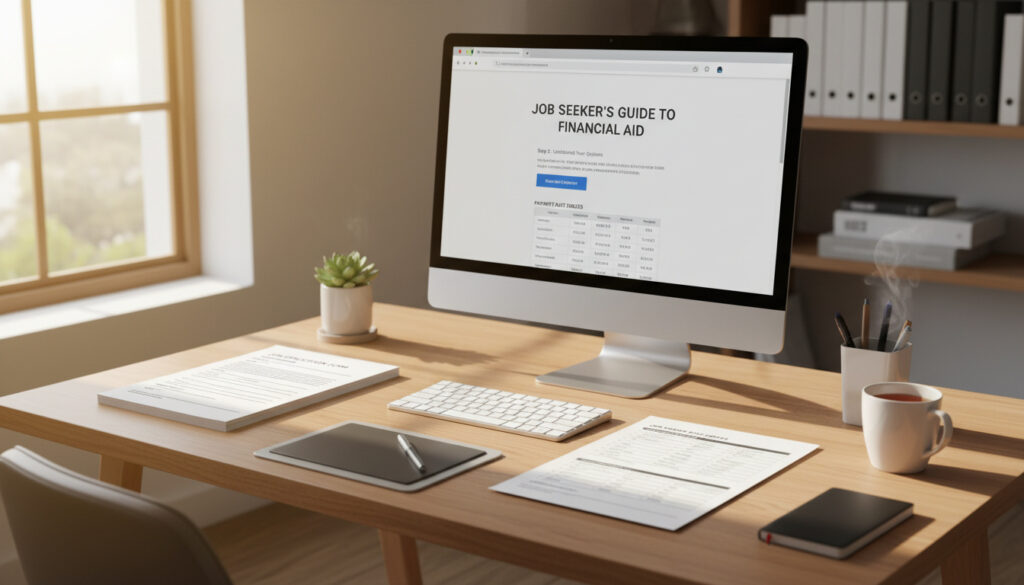
Job Seeker Payment – Rates Eligibility Application Guide
JobSeeker Payment serves as Australia’s primary fortnightly income support for unemployed individuals between the ages of 22 and Age Pension age. The benefit, which replaced Newstart Allowance in 2020, provides financial assistance to those actively seeking employment or temporarily unable to work due to illness or injury while meeting strict residence and means testing requirements.
The scheme operates under legislative guidelines administered by Services Australia, requiring recipients to satisfy mutual obligation commitments including job search activities and regular reporting. Payment rates adjust twice yearly through indexation, with current maximums reaching $808.70 per fortnight for single individuals without children.
Eligibility hinges on Australian residency, income and assets tests, and compliance with activity requirements. The payment is taxable, with optional upfront tax deductions available through Centrelink.
What is JobSeeker Payment?
Fortnightly income support for Australians aged 22 to pension age who are unemployed or temporarily incapacitated
$808.70 per fortnight (as of March 2026), with higher rates for parents and carers
Active job searching and participation in mutual obligation activities
Digital claims submitted via myGov linked to Centrelink
Key Facts:
- The scheme maintains the same fundamental purpose as the former Newstart Allowance, rebranded under current nomenclature in 2020.
- Rates index twice yearly on 20 March and 20 September, reflecting economic adjustments.
- Single principal carers exempt from mutual obligations receive the highest standard rate at $1,047.30 per fortnight.
- Strict assets test limits apply: $321,500 for single homeowners and $579,500 for single non-homeowners.
- The payment constitutes taxable income, with recipients able to arrange upfront tax deductions.
- Recipients must report income fortnightly and attend mandatory provider appointments.
| Situation | Category | Maximum Fortnightly Rate (Mar 2026) |
|---|---|---|
| Single, no children | Standard | $808.70 |
| Single, with dependent children | Parent | $866.00 |
| Single, 55+ after 9 months on support | Mature age | $866.00 |
| Single, partial capacity (<15 hrs/week) | Reduced capacity | $866.00 |
| Partnered | Couple | $740.30 |
| Single principal carer (exempt) | Carer | $1,047.30 |
Who is Eligible for JobSeeker Payment?
Age and Residency Requirements
Applicants must fall between the ages of 22 and Age Pension age, generally reaching up to 66 or 67 years depending on birth date. Australian residency is mandatory, requiring claimants to hold citizenship or permanent residency status and satisfy specific residence rules.
Eligibility excludes those currently receiving annual leave, sick leave, or income protection insurance payments. Individuals must demonstrate unemployment or inability to work or study short-term due to illness or injury.
Income and Assets Tests
Financial means testing determines actual payment amounts. Income above the free area—which varies by situation but generally falls around $857-$961 per fortnight—reduces the benefit incrementally. Partner income also affects eligibility, with combined assessments determining final entitlements.
Payment eligibility ceases if assets exceed $321,500 for single homeowners or $579,500 for single non-homeowners. Couples face combined limits of $481,500 (homeowner) and $739,500 (non-homeowner). These figures exclude the family home and personal effects. Services Australia publishes current thresholds with updates reflecting indexation.
How Much is JobSeeker Payment?
Current Fortnightly Rates by Category
Maximum payment rates effective from 20 March 2026 vary significantly based on personal circumstances. Single individuals without children receive $808.70, while those with dependent children or mature age recipients (55+ after nine continuous months on income support) qualify for $866.00.
Partnered individuals receive $740.30 each, while single principal carers granted exemptions from mutual obligations—such as foster carers, those homeschooling, or caring for large families—receive $1,047.30 per fortnight.
JobSeeker Payment constitutes taxable income. Recipients may opt for upfront tax deductions to avoid year-end liabilities. The Australian Taxation Office treats these payments as assessable income, affecting overall tax positions depending on other earnings.
Supplements and Add-ons
While the base rate forms the primary support mechanism, specific circumstances may trigger additional supplements. However, the research indicates no distinct savings allowance beyond the standard assets test, and remote area loadings follow standard rates unless specific exemptions apply.
How Do I Apply for JobSeeker Payment?
Online Application Steps
Claims proceed exclusively through digital channels. Applicants must establish or access existing myGov accounts linked to Centrelink, complete the online claim form, and upload supporting documentation. The Services Australia payment finder assists with preliminary eligibility estimates before formal submission.
Required Documentation
Documentation requirements vary by individual circumstance but typically include proof of identity, residency status, and comprehensive financial records detailing income and assets. Medical certificates support claims based on temporary incapacity.
Incomplete applications or missing documentation delays processing. Services Australia recommends gathering bank statements, tax file numbers, and employment separation certificates before commencing the online application to expedite assessment.
What Are the Mutual Obligations for JobSeeker Payment?
Job Search and Reporting Requirements
Recipients must actively seek employment, attend training, and maintain appointments with employment providers. Specific requirements vary according to assessed work capacity, with obligations tailored to individual circumstances and local labour market conditions. For more details on the Job Seeker Payment, including information on mutual obligations, please visit $civicpost.co.uk.
Exemptions and Penalties
Exemptions apply for principal carers of dependent children (including foster and non-parent relative care), individuals homeschooling, those with partial work capacity under 15 hours weekly, and recipients aged 55+ after nine months on long-term income support. Non-compliance with obligations results in payment reduction or suspension under standard Centrelink administrative rules.
When Do JobSeeker Payment Rates Increase?
- : Legislative transition completes, replacing Newstart Allowance with JobSeeker Payment while maintaining identical intent and structural framework.
- : Standard indexation adjustment applies to base rates.
- : Single rate without children reaches $778.00 per fortnight following regular indexation.
- : Mid-year indexation adjustment reflects Consumer Price Index movements.
- : Second 2025 indexation adjustment occurs.
- : Maximum single rate increases to $808.70 per fortnight, representing approximately 4% growth from prior-year figures.
What Information is Confirmed Versus Uncertain?
| Established Facts | Information Awaiting Confirmation |
|---|---|
| Payment rates index 20 March and 20 September | Specific budget allocations and policy changes beyond 2026 |
| Assets test limits: $321,500 (single homeowner) | Potential legislative changes to mutual obligation requirements |
| Eligibility age remains 22 to Age Pension age | Remote area loading policy specifics |
| Taxable status of payments confirmed | Future supplement structures or additional loadings |
How Does JobSeeker Payment Compare to Other Benefits?
Understanding the distinction between JobSeeker Payment and alternative Centrelink supports clarifies entitlement pathways. Bunnings Waurn Ponds – Opening Hours, Location, Phone and Services illustrates how local employment services interact with these federal support mechanisms, though specific staffing for Centrelink referrals varies by location.
Youth Allowance serves individuals under 22 years, offering lower rates—approximately $961.84 per fortnight for single 18+ job seekers living at home as of January 2025—while JobSeeker targets older unemployed workers. Parenting Payment provides superior financial support for primary carers, reaching approximately $1,011.50 per fortnight for single parents, though with stricter activity test requirements.
Unlike Disability Support Pension or Age Pension, JobSeeker maintains temporary status predicated on continuing unemployment and active job search, rather than permanent incapacity or retirement.
What Do Official Sources Confirm?
JobSeeker Payment is designed to provide income support while recipients actively seek employment or enhance their work readiness through approved activities.
— Services Australia official documentation
Services Australia maintains authoritative, current rate tables and eligibility criteria, while Department of Social Services publications provide detailed income test parameters. The Parliamentary Budget Office offers independent fiscal analysis of the scheme’s budget impacts.
Is JobSeeker Payment Appropriate for Your Situation?
Australian residents aged 22 to 67 facing unemployment or temporary incapacity who possess assets below test thresholds and agree to mutual obligations should consider applying. The scheme provides essential support while job searching, though recipients must balance reporting requirements with personal circumstances. Those seeking legal recourse for employment-related disputes might consult a Medical Malpractice Lawyer – Complete Hiring Guide for unrelated legal matters, ensuring appropriate professional advice for complex employment law issues.
Frequently Asked Questions
Can students receive JobSeeker Payment?
Generally no if under 22, as Youth Allowance covers students and apprentices. Those aged 22 and above may qualify if unemployed and meeting all other criteria.
What documents are required to apply?
Identity proof, residency documentation, tax file number, bank statements, employment separation certificates, and medical certificates if claiming temporary incapacity.
How does having savings affect eligibility?
Savings count toward the assets test. Single homeowners must hold less than $321,500 in total assets; non-homeowners less than $579,500.
Can I work part-time while receiving JobSeeker?
Yes, however income above the free area reduces payments. The exact threshold varies by situation, generally between $857-$961 per fortnight.
How long does the application process take?
Processing times vary based on claim complexity and documentation completeness. Online applications typically process faster than paper submissions.
What happens if I fail to meet mutual obligations?
Non-compliance results in payment reduction or suspension. Specific penalties depend on severity and frequency of missed requirements.
How does JobSeeker affect other Centrelink payments?
Receipt of JobSeeker generally precludes simultaneous receipt of other unemployment benefits, though specific combinations require individual assessment.
How long can I receive JobSeeker Payment?
No fixed time limit exists provided recipients continue meeting eligibility criteria and mutual obligation requirements.
More related posts
 Costco Fuel Marsden Park – Prices, Hours, Membership Guide
 Best Mobile Plans Ireland: Cheapest Deals & Coverage
 Mudbrick Herb Cottage: Organic Herbs, Plants & Skincare
 Nolan Gould: IQ, Modern Family, Ariel Winter & Current Life
 Rare Beauty: Owner, CEO, Worth & Where to Buy (2025 Guide)
 Han Solo: From Smuggler to Hero and Martyr in Star Wars
 Medical Malpractice Lawyer – Complete Hiring Guide
 Carrie Underwood: Apology, Miscarriages, and Surgery Rumors
