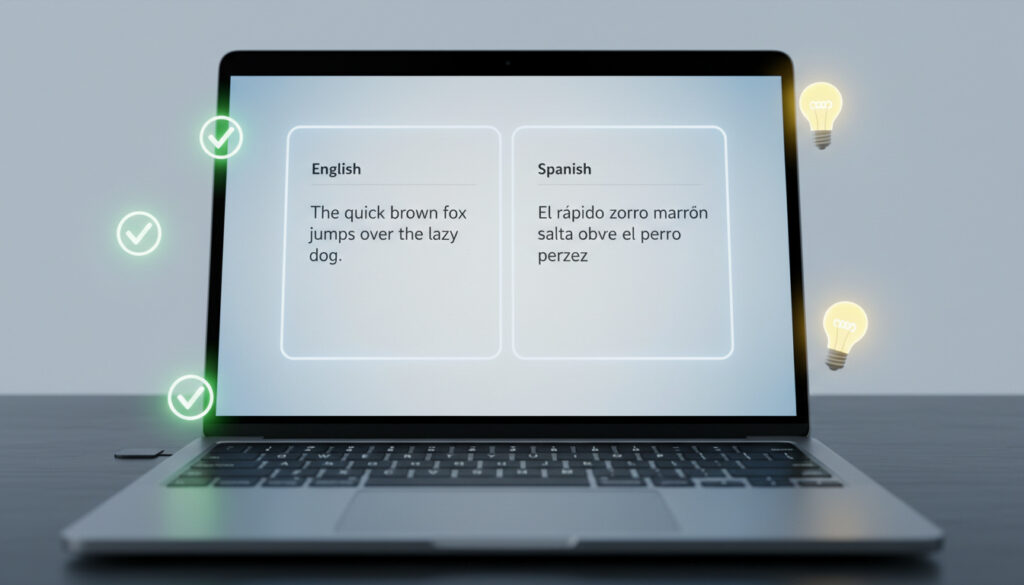
Traductor Google Inglés Español – Accuracy Guide and Tips
Google Translate processes billions of words daily between English and Spanish, serving as the most widely accessed free translation service globally. The platform leverages Neural Machine Translation technology to convert text, speech, and images across 133 languages, with particular strength in high-resource European language pairs.
The service operates through web browsers and mobile applications, offering instant translation without registration requirements. For English-Spanish specifically, independent studies demonstrate accuracy rates exceeding 90 percent for straightforward text, though performance varies significantly based on content complexity and domain specialization.
Users access the tool for diverse needs ranging from casual travel communication to academic research, yet critical applications require understanding its documented limitations in medical, legal, and idiomatic contexts.
How Accurate Is Google Translate for English to Spanish?
Instant translation without account registration or subscription fees.
Comprehensive coverage including major European, Asian, and African language pairs.
Text, voice, camera, and document upload capabilities for flexible usage.
Consistent core functionality across web browsers, iOS, and Android devices.
Key Performance Insights
- Over 90% accuracy achieved for simple English-Spanish sentences in controlled studies, outperforming French and German pairs which average 80-90 percent.
- Neural Machine Translation processes entire sentences contextually rather than translating word-by-word, reducing grammatical errors common in earlier statistical systems.
- 82.5% meaning preservation documented in a 2021 UCLA Medical Center study regarding English-Spanish medical instructions, falling within a broader 55-94 percent range across all tested languages.
- 92% precision recorded in a 2018 independent analysis specifically targeting English to Spanish translation quality.
- 34% improvement in Spanish translation quality between 2011 and 2019 evaluations, reflecting continuous algorithm refinement.
- 57.7% accuracy for complex medical terminology, indicating significant risk in healthcare applications without human verification.
- 72% reliability for literary and informal text containing slang or cultural references.
| Feature | Specification |
|---|---|
| Launch Year | 2006 |
| Languages Supported | 133 (24 added 2022) |
| English-Spanish Accuracy Range | 82.5% – 94% |
| Core Technology | Neural Machine Translation (NMT) |
| Available Platforms | Web, iOS, Android |
| Cost Structure | Free |
| Offline Capability | Yes (requires download) |
| Voice Translation | Real-time speech recognition |
| Document Support | PDF, DOC, DOCX |
| Industrial Domain Score | 86.01 (English-Spanish) |
How Do You Use Google Translate: Web vs. Mobile?
Web Interface Functionality
The browser-based version provides straightforward text input with immediate translation output. Users select source and target languages from dropdown menus, with automatic language detection available. The web platform supports document uploads up to 10 megabytes, preserving basic formatting in translated PDF and Word files.
Mobile Installation and Setup
Download the application through the Apple App Store or Google Play Store by searching “Google Translate.” Upon installation, the app requires permissions for camera access and microphone input to enable full functionality. Medical Malpractice Lawyer – Complete Hiring Guide resources emphasize verifying critical health-related translations through professional services rather than automated tools.
Download offline language packs before international travel to ensure translation capability without cellular data or Wi-Fi connectivity. Access through the menu icon, select “Offline translation,” and download both English and Spanish packs (approximately 35-50MB each).
Platform-Specific Differences
The mobile application offers exclusive features unavailable on web versions, including augmented reality camera translation, real-time conversation mode for bilingual dialogue, and handwriting input recognition. The web interface focuses primarily on text and document translation, sharing the core Neural Machine Translation engine but lacking mobility-specific tools. Recent accuracy analyses confirm both platforms deliver identical translation quality for text-based inputs.
What Advanced Features Support English-Spanish Translation?
Voice Conversation Mode
The conversation feature enables real-time bilingual dialogue by automatically detecting speaker languages and translating speech instantly. Users activate the microphone icon and speak naturally; the system transcribes and translates simultaneously, displaying text in both languages while playing audio output. This functionality requires stable internet connectivity and performs optimally with clear pronunciation and minimal background noise.
Camera and Image Translation
Point the mobile camera at printed text—such as menus, street signs, or documents—and the application overlays English or Spanish translations directly onto the live image. The technology recognizes printed characters in 37 languages, though handwriting recognition remains inconsistent. Users may also upload existing photos from their gallery for instant text extraction and translation.
Document Processing Capabilities
Upload PDF, DOC, or DOCX files through the web interface or mobile app for full-document translation. The system preserves basic structural elements including paragraph breaks and bullet points, though complex formatting may require manual adjustment. Technical evaluations indicate document translation maintains similar accuracy rates to standard text input for English-Spanish pairs.
Where Does Google Translate Fail for English-Spanish?
Medical and Legal Risks
The 2021 UCLA Medical Center study identified significant errors in pharmaceutical dosage instructions and diagnostic terminology, with accuracy dropping to 82.5 percent for medical content. Legal documents present similar challenges, with contractual language and nuanced liability terms frequently mistranslated due to context-dependent meanings. Professional translation assessments consistently advise against using automated tools for official documentation where precision carries legal or health consequences.
Avoid reliance on Google Translate for medical instructions, legal contracts, or emergency services communication. Misinterpretation risks include incorrect medication dosages, misunderstood legal rights, or dangerous miscommunication during police interactions.
Idiomatic and Cultural Barriers
Colloquial expressions, regional slang, and culturally-specific references translate literally rather than conceptually, producing nonsensical output. Literary text achieves only approximately 72 percent accuracy, with poetry and creative writing suffering particularly from the system’s inability to recognize metaphorical language or tonal nuance. Comparative studies demonstrate that isolated terms without contextual sentences generate higher error rates than complete sentences.
The system processes words most accurately within complete sentences. Single-word queries or isolated phrases frequently return incorrect meanings due to multiple possible definitions (polysemy) in both English and Spanish.
Dialect and Regional Variation
Spanish dialectical differences between Spain, Mexico, Argentina, and other regions create inconsistencies that the generalized model cannot consistently resolve. Regional vocabulary, verb conjugations specific to certain countries, and local idioms may produce translations appropriate for one dialect but confusing or inappropriate for another.
How Has Google Translate Evolved Since Launch?
- : Initial launch utilizing Statistical Machine Translation, which analyzed bilingual text corpora to predict word probabilities without understanding grammatical structure.
- : Implementation of Google Neural Machine Translation (GNMT), enabling context-aware processing of entire sentences rather than fragmented phrases. Post-2016 evaluations document substantial accuracy improvements across all supported language pairs.
- : Algorithmic refinements produced a 34% accuracy increase for Spanish translations specifically, narrowing the gap with professional human translation for basic content.
- : Expansion to 133 total languages with the addition of 24 new language packs, primarily serving indigenous and low-resource populations.
- : Integration of real-time conversation enhancements and augmented reality features for mobile platforms, improving practical usability for travelers and immersive language learners.
What Can You Trust vs. What Requires Verification?
Established Reliability
- Literal vocabulary translation exceeds 90% accuracy
- Standard grammar constructions in formal writing
- High-resource language pairs (Spanish, French, German)
- Common travel phrases and directional queries
- Technical terminology in industrial domains
Persistent Uncertainty
- Idiomatic meaning preservation varies significantly
- Slang and internet neologisms
- Handwriting recognition consistency
- Context-dependent homonym resolution
- Low-resource language pair performance
How Does Neural Machine Translation Work?
Neural Machine Translation represents a paradigm shift from the phrase-based statistical models used prior to 2016. Rather than breaking sentences into discrete segments and translating them independently, NMT processes entire sequences through deep learning networks trained on millions of bilingual sentence pairs.
The system analyzes contextual relationships between words, considering how surrounding vocabulary influences meaning. For English-Spanish specifically, training data derives from over 500 million Spanish speakers’ online content, European Union documents, and professionally translated books. Linguistic analyses confirm this extensive training corpus explains Spanish’s higher accuracy compared to low-resource languages like Armenian, which achieve only 55 percent precision.
Despite these advances, the technology remains fundamentally pattern-matching rather than true comprehension. It cannot reason about content, recognize cultural subtleties, or verify factual accuracy within translated material.
What Do Independent Studies Conclude?
“Google Translate achieved over 90% accuracy for English-Spanish translations in our comprehensive evaluation of 18 major machine translation engines, ranking first for this language pair though trailing DeepL in French and German fluency.”
Intento Machine Translation Report, 2022
“Meaning preservation for English-Spanish medical instructions reached 82.5% overall, with significant variation between simple directions (94%) and complex pharmaceutical terminology (57.7%), necessitating human verification for clinical applications.”
UCLA Medical Center Study, 2021
“While Google Translate handles high-resource European languages with increasing sophistication, both isolated terms and specialized domain content require expert human review to ensure precision.”
Final Assessment: When Should You Use Google Translate?
Google Translate provides reliable English-Spanish conversion for casual communication, travel navigation, and general comprehension of web content, delivering over 90 percent accuracy for straightforward text. However, professional, medical, or legal contexts demand human translators familiar with domain-specific terminology and cultural nuance. For entertainment and media context, consider exploring Monarch Legacy of Monsters – Plot Cast MonsterVerse Guide to understand how translation accuracy impacts international content consumption.
Frequently Asked Questions
Is Google Translate completely free for English-Spanish?
Yes. The service charges no fees for text, voice, or document translation between English and Spanish on both web and mobile platforms.
Can Google Translate work without internet connection?
Yes, but you must download offline language packs beforehand through the mobile app’s settings menu. Offline mode supports text translation but not camera or conversation features.
How does Google Translate compare to DeepL?
DeepL often produces more natural-sounding European language translations, including Spanish, while Google Translate supports significantly more languages overall and offers superior mobile features.
Why does Spanish translation sometimes contain errors?
Accuracy decreases with complex grammar, idioms, regional dialects, or specialized terminology. The system processes patterns rather than understanding meaning, leading to contextual mistakes.
Is it safe to translate medical documents?
No. Studies show 82.5% meaning preservation for medical content, with potentially dangerous errors in dosage instructions. Always use certified medical translators for health-related documents.
How do I translate a PDF file?
Click the document icon in the web interface or mobile app, upload your PDF, and select English to Spanish. The translated document downloads as a viewable file with preserved formatting.
Does Google Translate store my conversations?
Translation history saves to your Google account when signed in. You can delete individual entries or disable history entirely through privacy settings in the mobile application.
More related posts
 Margaret Court: 24 Grand Slams, Controversy, and the GOAT Debate
 Jonathan Joss, King of the Hill actor, shot dead at 59
 Sophie Thatcher: Twin Sister, Accident & Verified Facts
 Iga Swiatek: Biography, Career, Relationship & Doping Case
 Elijah Blue Allman: Conservatorship, Family, Net Worth
 Quinn Finite: Real Name, Age, Height & More
 Cricket Scores Ashes – Australia Retains Urn in 2023 Draw
 Is Hong Kong a Country? Status and Relationship with China
