Leaning Tower of Pisa – Height, Tilt Causes and Visit Guide
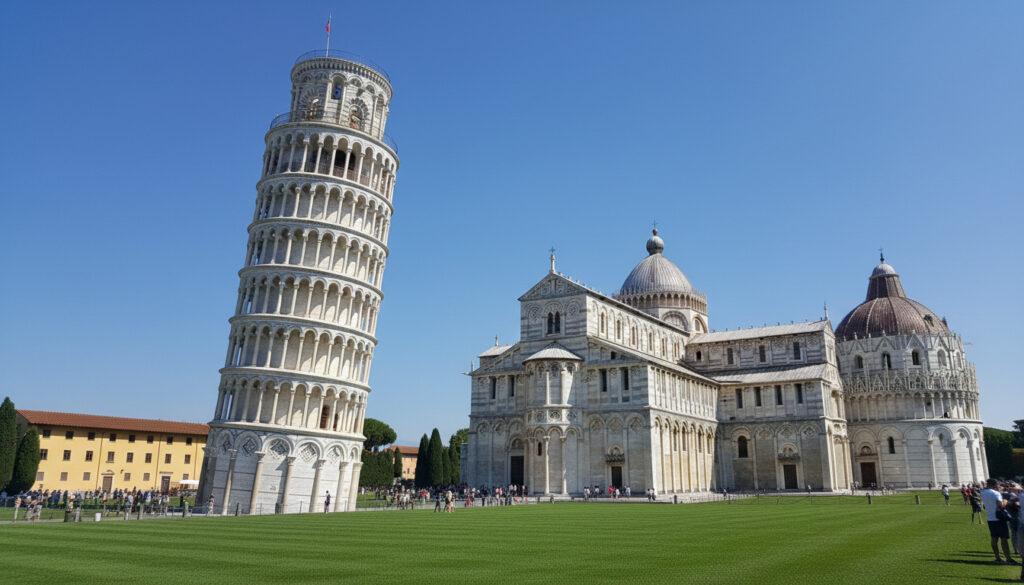
The Leaning Tower of Pisa stands as one of Italy’s most recognizable landmarks, its distinctive tilt visible from across the Piazza dei Miracoli. Built as a campanile for the adjacent cathedral, this white marble cylinder has defied gravity for over eight centuries, drawing millions of visitors annually to climb its spiraling staircase.
The incline was never an architectural intention. Instead, it emerged from a fundamental miscalculation regarding the soil beneath the foundation—a miscalculation that ultimately required centuries of engineering intervention to prevent catastrophe. Today, stabilized at a precise angle, the tower offers both a cautionary tale of medieval construction limitations and a testament to modern geotechnical preservation.
The sections below detail the geological mechanisms causing the tilt, provide exact structural measurements, and outline practical visiting information for 2025.
Why Is the Leaning Tower of Pisa Leaning?
56m (low side)
58m (high side)
3.99°
(post-2001)
294
to summit
1173–1372
Nearly 200 years
- Soil subsidence occurred on unstable, compressible marshy soils immediately beneath the foundation
- Foundation depth reached only 3 meters, insufficient for the tower’s 14,500-tonne weight
- Differential settlement caused the south side to sink significantly more than the north
- A century-long construction pause (1198–1272) allowed partial soil consolidation, preventing immediate collapse
- The lean angle reached a critical 5.5 degrees by 1990 before stabilization reduced it to 3.99 degrees
- Upper soil layers consist of variable silty-clay deposits from lagoonal sedimentation
- Underlying “Pancone” clay layers extend from 10 to 40 meters deep
| Fact | Detail |
|---|---|
| Location | Piazza dei Miracoli, Pisa, Italy (Source) |
| Material | White marble |
| Total Weight | 14,500 tonnes |
| UNESCO Status | World Heritage Site (Piazza dei Miracoli) |
| Current Lean | 3.99 degrees (reduced from 5.5°) |
| Height Discrepancy | 56m (low side) / 58m (high side) |
| Stair Count | 294 spiral steps |
| Foundation Depth | 3 meters |
| Construction Period | 1173–1372 |
| Safety Factor | Exceeds 2.0 (post-stabilization) |
| Soil Composition | Layer A: Silty-clay (0-10m); Layer B: Pancone clay (10-40m) |
| Water Table | 1–2 meters below surface |
The tilt originated specifically from differential settlement where the south-side soils—siltier and more clayey with thinner sand layers—compressed more than the northern strata. This uneven compression began manifesting after completion of the third story in 1178, forcing builders to halt construction for nearly a century.
How Tall Is the Leaning Tower of Pisa and How Much Does It Lean?
Precise measurements reveal the tower stands approximately 56 meters on its low side and 58 meters on its high side, creating a height difference of roughly two meters caused entirely by the incline. This variation makes it one of the few structures worldwide where elevation depends on which side one measures from.
Structural Dimensions
The structure contains exactly 294 steps ascending via a spiral staircase that becomes noticeably tilted as climbers ascend. The total weight of 14,500 tonnes distributes unevenly across the foundation, exacerbating the soil compression issues that began in the 12th century.
The Lean Angle in Context
Currently stabilized at 3.99 degrees, the tower leans approximately 3.9 meters off vertical. Engineers consider this angle optimal for stability—sufficient to maintain the historic character while ensuring the center of gravity remains within the foundation footprint. Prior to the 1990s intervention, the lean had reached 5.5 degrees with a safety factor of merely 1.07, approaching the critical threshold that caused a similar tower in Pavia to collapse in 1989.
The tower’s height varies by approximately 2 meters between the north and south sides due to the tilt. Measurements are taken from the ground level on each respective side, not from the foundation base.
Why Doesn’t the Leaning Tower of Pisa Fall Over?
Geological Self-Stabilization
The tower persists through a combination of soil consolidation over eight centuries and the peculiar mechanics of its rotation. Rather than sinking uniformly, the foundations rotate in a circular motion within the soft sediments, a movement that self-limits extreme tilting. The shallow water table, sitting only 1–2 meters deep, contributes to this complex soil behavior.
Engineering Interventions
Between 1990 and 2001, engineers implemented underexcavation techniques to reduce the lean. This process involved carefully extracting 38 cubic meters of soil from beneath the north side through 41 boreholes, effectively allowing the tower to settle back toward vertical by 0.5 degrees. Temporary counterweights totaling 600 tonnes and steel cables secured the structure during this delicate operation.
Current Safety Margins
Post-stabilization assessments confirm the tower now maintains a safety factor exceeding 2.0, more than double the precarious 1.07 margin of the 1990s. Geotechnical models indicate the structure could withstand seismic activity, with no significant further leaning detected since the 2001 intervention.
Can You Climb the Leaning Tower of Pisa?
Access and Restrictions
Visitors may ascend the tower via its spiral staircase, though height restrictions apply—those exceeding 200 centimeters may find the narrow passages challenging. The climb requires timed entry tickets booked in advance through the official Opera della Primaziale Pisana website.
Standard adult tickets range from €20–25 with reduced rates for youth and seniors; children under 10 enter free. Combo tickets covering the full Piazza dei Miracoli complex cost approximately €27. Entry slots fill quickly during peak season.
Optimal Visiting Conditions
Located within the UNESCO-listed Piazza dei Miracoli, the tower operates typically from 9 AM to 7 PM during high season, with reduced winter hours. Last entry occurs 30–60 minutes before closing. Early morning visits between 8–10 AM or late afternoon slots offer thinner crowds and optimal lighting for photography.
The tower closes during adverse weather conditions, specifically high winds or thunderstorms, due to safety protocols. Christmas and Easter holidays also affect operating schedules.
For travelers planning broader Italian itineraries, consider reviewing Au Post Tracking – Guide to Statuses and Troubleshooting for logistics coordination, or finding recreation nearby through Golf Course Near Me – Closest, Top-Rated Public Options. For travelers planning broader Italian itineraries, consider reviewing Au Post Tracking – Guide to Statuses and Troubleshooting for logistics coordination, or finding recreation nearby through Golf Course Near Me – Closest, Top-Rated Public Options, and don’t forget to explore ${innovazione italiana startup aziende tendenze 2026}. innovazione italiana startup aziende tendenze 2026
History and Restoration of the Leaning Tower of Pisa
- : Construction initiates under architect Bonanno Pisano as a campanile for Pisa Cathedral.
- : Tilt becomes apparent after completion of the third story, triggering a construction halt.
- : Work officially pauses, allowing soils to consolidate for the next century.
- : Construction resumes under Giovanni di Simone, who attempts to compensate by curving upper stories—a visual correction visible today.
- : Final completion under Tommaso di Sano, nearly 200 years after groundbreaking.
- : Tower closes to public access as the lean reaches 5.5 degrees and safety factors drop to critical levels.
- : Trial underexcavation successfully reduces tilt by 0.02 degrees, validating the stabilization approach.
- : Full stabilization completed, lean reduced to 3.99 degrees; tower reopens to public.
Sources: Geoengineer.org, Practical Engineering
What Do We Know for Certain About the Tower’s Future?
Established Facts
- Lean reduced from critical 5.5° to stable 3.99° in 2001
- Safety factor now exceeds 2.0, double the 1990 margin
- Weight confirmed at 14,500 tonnes
- Soil composition verified as silty-clay over Pancone clay layers
- No measurable movement detected since stabilization
- Survived WWII bombings due to its lean making it a poor target
Remaining Uncertainties
- Long-term behavior depends on continuous monitoring
- Precise response to major seismic events remains modeled but untested
- Ticket prices for 2025 season subject to annual adjustment
- Exact timeline for future maintenance interventions unclear
How Does the Tower Fit Into Its Historical Context?
The campanile represents one component of the Piazza dei Miracoli, a walled complex comprising the cathedral, baptistery, and cemetery that illustrates Pisa’s maritime dominance during the medieval period. Built as a statement of civic pride and religious devotion, the tower’s Romanesque architecture reflects the wealth generated by Pisa’s naval victories and Mediterranean trade routes.
Its survival through centuries of conflicts, including Allied bombings during World War II, has transformed the structure from a construction failure into an unintended icon. The tilt, rather than condemning the monument, ultimately distinguished it from countless other campaniles across Italy, contributing to the piazza’s designation as a UNESCO World Heritage Site.
Modern preservation efforts balance tourist access with geological realities, ensuring the tower remains accessible while maintaining the very imperfection that defines its global significance.
Expert Sources and Engineering Authority
Stabilization data derives from the International Committee for the Safeguarding of the Tower of Pisa, which conducted extensive borehole investigations and soil testing between 1990 and 2001. Geotechnical analysis published in Ingenia and Geological Digressions confirms the soil extraction methodology and long-term monitoring protocols. Official visitor information originates from the Opera della Primaziale Pisana, the ecclesiastical administration governing the piazza complex.
Summary
The Leaning Tower of Pisa stands stabilized at 3.99 degrees, its 14,500 tonnes supported by soils stabilized through modern underexcavation techniques. Visitors climbing the 294 steps experience both medieval architectural ambition and cutting-edge geotechnical preservation. For those planning a visit, early morning arrivals and advance ticket purchases through official channels ensure optimal access to this UNESCO World Heritage landmark. Travelers may also find Golf Course Near Me – Closest, Top-Rated Public Options useful for planning recreational activities in the region.
Frequently Asked Questions
Where exactly is the Leaning Tower of Pisa located?
The tower stands in the Piazza dei Miracoli (Square of Miracles) in Pisa, Italy, alongside the cathedral, baptistery, and cemetery.
How old is the Leaning Tower of Pisa?
Construction began in 1173 and completed in 1372, making the structure approximately 650–850 years old depending on which phase is referenced.
How do I purchase tickets to climb the tower?
Book timed entry tickets online through the official Opera della Primaziale Pisana website. Standard adult tickets cost approximately €20–25, with combo options available.
When is the best time to visit to avoid crowds?
Visit between 8–10 AM or late afternoon on weekdays during spring or fall for mild weather and minimal crowds.
What materials compose the tower?
The structure consists primarily of white marble, weighing approximately 14,500 tonnes.
Is the tower safe to enter?
Yes. Since the 2001 stabilization, the safety factor exceeds 2.0, and continuous monitoring ensures structural integrity.
Why did the tower close in 1990?
Engineers closed the tower when the lean reached 5.5 degrees with a safety factor of 1.07, nearing the collapse threshold experienced by a similar tower in Pavia in 1989.
More related posts
 Google Cloud Console: Free Access, Pricing & How-To Guide
 Robot Vacuum and Mop – Lab-Tested Best of 2024
 Ghislaine Maxwell: Conviction, Appeal, and 2026 Updates
 Sausage Dogs: Dachshund Temperament, Health & Care Guide
 Chemist Warehouse Pimpama – Address, Hours, Phone & Services
 Simon Baker: DUI, Net Worth, and Personal Life (2024)
 AFL Trade News 2025 – Confirmed Deals and Key Dates
 Kia Tasman Price – 2025 Australia Pricing and Specs
